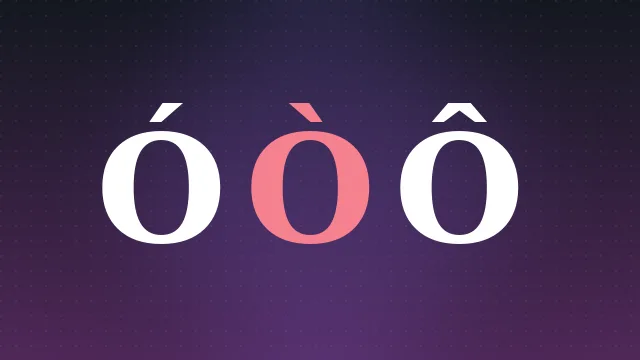
People often search for an O with accent mark without knowing that there are many different marks, each with its own name and job. This guide names every accent that sits on the letter O, explains what it does to the sound, and helps you tell nearly identical marks apart.
What A Diacritical Mark Is
A diacritical mark, or diacritic, is a small sign added to a letter to change how it is pronounced or to distinguish it from a similar word. On the letter O these marks are not optional flourishes; leaving one off changes the spelling and, in many languages, the meaning. The marks below are the ones you will meet most often.
The Marks That Sit Above
The acute accent, as in Ó, is a stroke rising to the right. It most often marks stress or a raised pitch, and it is the only accent Spanish places on an O. The grave accent, Ò, leans the other way and typically marks a lower or open sound, common in Italian and Catalan.
The circumflex, Ô, looks like a little roof and often signals a long or closed vowel, or in French a letter that was dropped centuries ago. The tilde, Õ, is a wave that marks nasal vowels in Portuguese. The two dots, Ö, are an umlaut or diaeresis depending on the language.
The Rarer Marks Above
The macron, Ō, is a flat bar marking a long vowel, used in Latin and romanised Japanese. The breve, Ŏ, is a small cup marking a short vowel. The caron, Ǒ, is a little check used in Mandarin pinyin for the dipping third tone. The double acute, Ő, is a Hungarian mark for a long front rounded vowel.
A memory aid: the direction and shape of the mark usually hint at the sound. A rising acute lifts the pitch, a falling grave drops it, and a roof shaped circumflex often lengthens the vowel.
The Marks That Change The Body Of The O
Not every mark sits on top. The stroke, Ø, cuts through the O and, in Danish and Norwegian, makes an entirely separate letter rather than an accented O. The ogonek, Ǫ, hooks off the bottom right to mark nasalisation in languages such as Navajo. Vietnamese and several African languages add a dot below.
Telling Similar Marks Apart
Two pairs cause the most confusion. The acute and the grave lean in opposite directions, so picture a hill: the acute climbs to the right, the grave slides to the left. The circumflex and the caron are mirror images, the circumflex pointing up like a roof and the caron pointing down like a tick. When in doubt, compare them directly in the finder, which shows each character at a large size.
Choosing The Right Mark
The safest way to pick the correct mark is to start from the language. If you are writing Spanish, you only ever need the acute. Portuguese wants the tilde and the circumflex. German wants the two dots. Once you know the language, the choice usually narrows to one or two options, and the finder lets you copy the exact character without second guessing.
In Summary
An O with accent mark could mean any of a dozen different signs, from the everyday acute and grave to the specialist caron and ogonek. Each has a name, a sound and a home language. Learn to read the mark and you can name the letter; start from the language and you can always choose the right one.