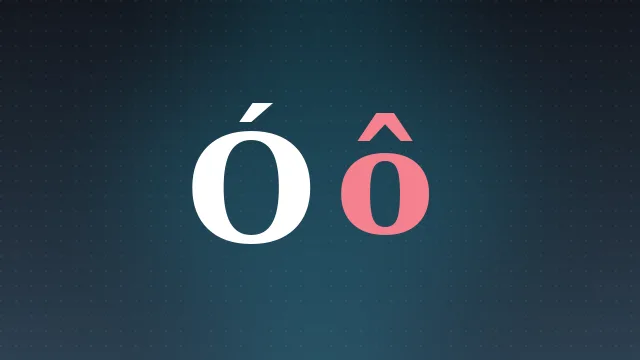
An accent mark on an O is not just a spelling detail; it usually tells you how to say the letter. But the same mark can do different things in different languages. This guide walks through what each accent does to the sound of O across Spanish, French, Portuguese and German, so you know what you are hearing as well as reading.
The Accent As A Pronunciation Guide
Diacritics on vowels typically carry one of three kinds of information: which syllable is stressed, whether the vowel is open or closed, or whether it is nasal. Knowing which job a mark does in a given language turns a confusing symbol into a clear instruction.
Spanish: Stress, Not Sound
In Spanish the acute Ó marks stress and nothing else. The vowel sound stays the same clean O; the accent only tells you to put the emphasis there. So canción is pronounced with the weight on the final syllable, but the O itself sounds exactly as it would without the mark.
Spanish is the easy case: the accent moves the stress, never the sound. If you can say a plain O, you can say an accented one; you just say it louder.
French: A Trace Of History
French uses the circumflex Ô, which often marks a closed O sound and frequently sits where a letter, usually an s, was dropped centuries ago. The grave and acute are rarer on French O. The circumflex O tends toward a rounded, closed sound, as in the exclamation ô.
Portuguese: Open, Closed And Nasal
Portuguese is the richest case for the O. The acute ó marks a stressed open O, a wider sound. The circumflex ô marks a stressed closed O, a narrower sound. And the tilde õ marks a nasal O, where the sound resonates through the nose, as in informações.
So in Portuguese the mark tells you three separate things at once about a single vowel: where the stress falls, how open the mouth is, and whether the sound is nasal. It is the accent system that rewards the closest attention.
German: A Different Vowel Entirely
German's two dot Ö is not a modified O at all in the way the others are. It represents a distinct rounded front vowel, close to the sound in the English word her without the r. This is why German treats it almost as its own letter, and why substituting a plain O changes the word rather than just its emphasis.
Hearing The Difference
The best way to internalise these sounds is to hear native speakers say minimal pairs, words that differ only in the accented vowel. Language learning apps and pronunciation dictionaries provide these recordings. Reading about the sound gets you halfway; hearing it closes the gap.
In Summary
An accented O can mark stress, as in Spanish; a closed sound and lost letter, as in French; open, closed or nasal quality, as in Portuguese; or an entirely different vowel, as in German. The mark is a pronunciation instruction whose meaning depends on the language, so always read it in context.