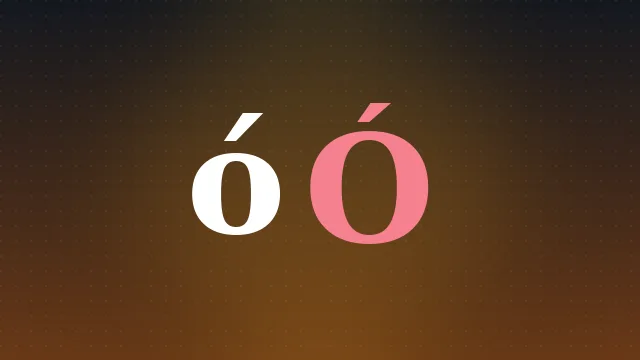
Spanish keeps its accent system refreshingly simple compared with many languages, and the letter O is a good example. There is exactly one accented O in Spanish, the acute Ó, and a clear set of rules decides when it appears. This guide explains those rules, shows the words where the accent turns up, and gives you the fastest ways to type it.
Only One Accent On O
Unlike Italian or Portuguese, Spanish never uses a grave, circumflex or tilde on an O. The only mark is the acute, written Ó for the capital and ó for the lowercase. That single fact removes most of the guesswork: if you are writing Spanish and reaching for an accented O, it is always the acute.
What The Accent Does
The Spanish acute marks which syllable is stressed. It does not change the vowel sound, only the emphasis. Spanish has default stress rules, and the written accent appears precisely when a word breaks those defaults, telling the reader where to put the weight.
The accent is a signpost for stress, not a change of sound. An O with an acute is pronounced the same as a plain O; it simply carries the emphasis of the word.
The Default Stress Rules
Words ending in a vowel, or in the letters N or S, are normally stressed on the second to last syllable. Words ending in any other consonant are normally stressed on the last syllable. When a word does not follow these patterns, a written accent marks the stressed vowel. That is why canción carries an accent: it ends in N but is stressed on the final syllable, against the default.
Common Words With Ó
The accented O appears constantly in everyday Spanish. You will see it at the end of many nouns such as canción, corazón, rincón and limón, and in the past tense of verbs like habló, comió and vivió. In each case the accent falls on the O because the stress lands there against the default rule.
Accents That Change Meaning
Spanish also uses accents to tell apart words that are otherwise spelled identically, though this is more common on other vowels. The principle still matters: dropping an accent is a spelling error, not a stylistic choice, and it can make a word ambiguous or wrong.
Typing Ó Quickly
If you write Spanish often, the Spanish keyboard layout or the US International layout makes the acute easy: you type the accent key, then the O. For occasional use, the Windows Alt code is Alt 0211 for the capital and Alt 0243 for the lowercase. On a Mac, hold Option and E, then press O. On a phone, press and hold the O key and slide to the accented option. Or simply copy the exact character from the finder.
In Summary
In Spanish, an accented O is always the acute, and it appears whenever the stress falls on the O against the language's default rules, as in canción and corazón. The mark shows emphasis, not a new sound, and leaving it off is a genuine spelling mistake. Learn the stress rules, or lean on the tool, and you will place it correctly every time.