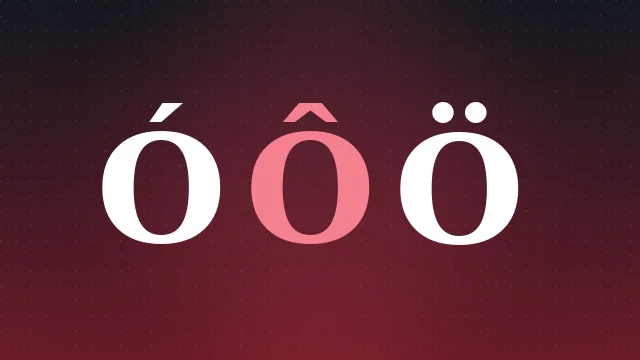
The phrase O with accent covers a surprising number of different characters. A single letter O can carry an acute stroke, a grave one, a little roof, a wave, two dots or a slash straight through it, and each version belongs to a different language and a different sound. This guide maps the whole family, explains what makes them distinct, and shows the quickest ways to get any of them onto your screen.
If you only need the character right now, the finder at the top of the site lets you search and copy any accented O in one tap. If you want to understand what you are copying, read on.
What Counts As An Accented O
An accented O is the base letter O with a diacritical mark added. The mark is not decoration. It usually signals a change in stress, in vowel quality or in tone, and in a few languages it turns the O into a letter of its own. The most common members of the family are the acute Ó, the grave Ò, the circumflex Ô, the tilde Õ, the diaeresis or umlaut Ö and the stroke Ø.
Beyond those there is a longer tail: the macron Ō used in Latin and romanised Japanese, the double acute Ő of Hungarian, the caron Ǒ of Mandarin pinyin, and the horned and dotted forms of Vietnamese. Each is a real Unicode character with its own code point, not a trick of styling.
The Marks And Where They Belong
Grouping the accents by language is the fastest way to remember them. The acute O shows up in Spanish, Polish and Icelandic. The grave O is Italian and Catalan. The circumflex belongs to French and Portuguese, the tilde to Portuguese and Estonian, and the two dots to German, Swedish and Turkish. The stroke is Danish and Norwegian.
The short version: the mark tells you the language before you have read a single other letter. A tilde over an O almost always means Portuguese, a stroke almost always means Scandinavian.
Marks That Sit Above
Most O accents sit on top of the letter: the acute, grave, circumflex, tilde, macron, caron, breve and the two dots. These are the ones people mean when they search for an O with something above it. Our companion guide on accents above the O compares them side by side.
Marks That Sit Through Or Below
A smaller set changes the letter in other ways. The stroke cuts through the bowl of the O, the ogonek hooks off the bottom, and Vietnamese and several African languages place a dot below. These are rarer but no harder to copy from the tool.
Three Ways To Produce An Accented O
There are three reliable routes. The first is copy and paste, which works everywhere and needs nothing to be installed. The second is a keyboard shortcut, such as a Windows Alt code or a Mac Option key combination, which is faster once memorised. The third is a language specific keyboard layout, which is worth setting up if you type a language constantly.
For occasional use, copying is simplest. For daily use in one language, a layout wins. The Alt code guide, the Mac guide and the Windows guide each cover a route in depth.
Why The Right Character Matters
Accents are not interchangeable. Writing a Spanish word with a grave instead of an acute, or dropping the mark entirely, changes the spelling and can change the meaning. In search engines and databases, a stripped or wrong accent can make a name fail to match. Copying the exact character, rather than approximating it, keeps text correct and findable.
In Summary
The O with accent is not one character but a whole family, each with a specific mark, language and purpose. Learn to recognise the mark and you can place the letter; copy the exact character and your text stays correct wherever it lands. Start with the finder, keep this guide for the background, and reach for the language specific articles when you want to type rather than paste.